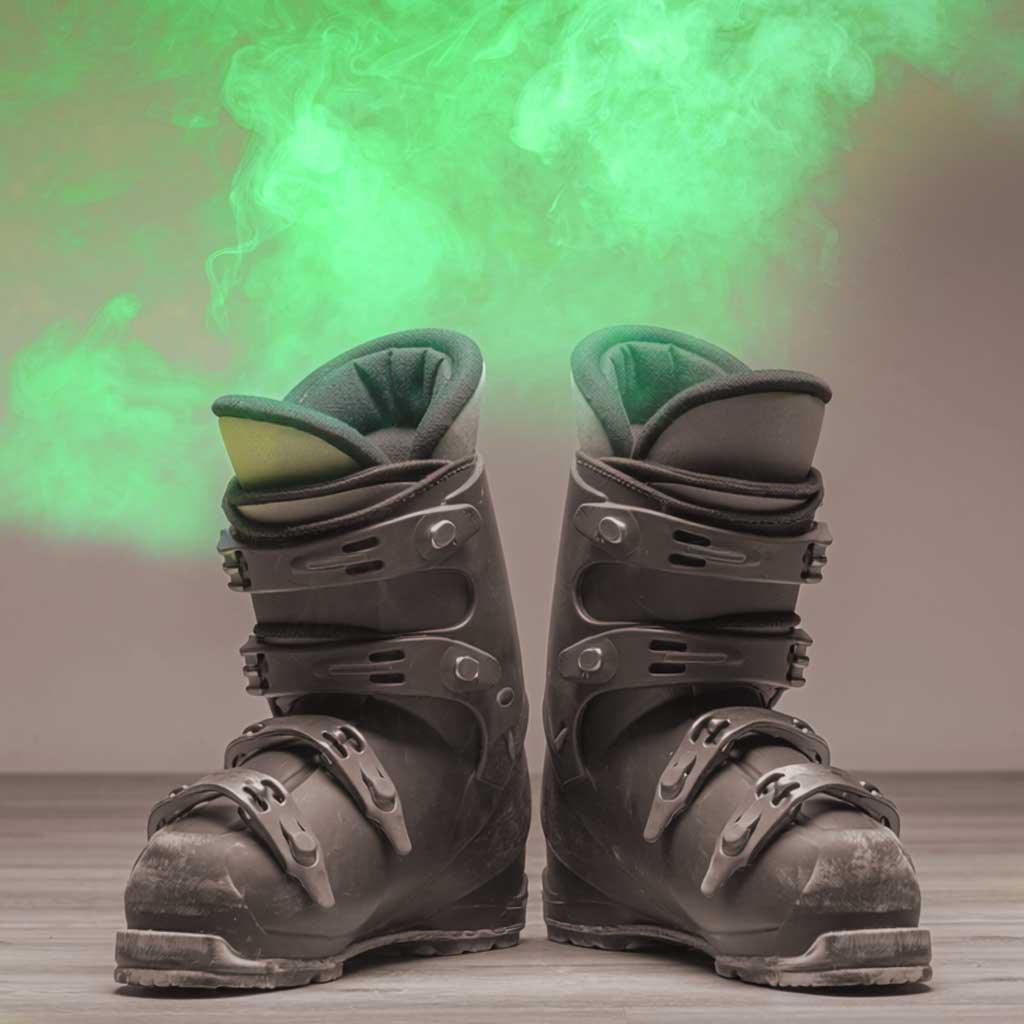
If you’ve ever opened a gear bag after a ski trip and questioned what crawled in there to die, you already know the smell. It clings. It survives febreze. It comes back within hours of using the boots again. And if you’ve been treating it as a sweat problem, you’ve been treating the wrong problem.
Why Your Ski Boots Smell (And What Actually Fixes It)
If you’ve ever opened a gear bag after a ski trip and questioned what crawled in there to die, you already know the smell. It clings. It survives febreze. It comes back within hours of using the boots again. And if you’ve been treating it as a sweat problem, you’ve been treating the wrong problem. Sweat doesn’t smell. Bacteria do. Specifically, bacteria living in your boot liner produce volatile compounds — isovaleric acid, butyric acid, and a cocktail of sulfur-based molecules — as byproducts of feeding on the proteins, lipids, and dead skin cells suspended in your sweat. Once you understand that, every odor solution either works or doesn’t based on a single question: does it actually kill the bacteria, or does it just cover the smell?
What’s Living in Your Ski Boots
Foot-related odor is driven by a handful of bacterial species, with two doing most of the heavy lifting:
- Staphylococcus epidermidis — the dominant resident on human feet. Produces isovaleric acid, the compound responsible for the sharp, cheesy note in stale boots.
- Brevibacterium linens — yes, the same organism used to ripen Limburger and Munster cheeses. Thrives in warm, moist, low-oxygen environments. Produces sulfur compounds responsible for the deeper, more pungent notes.
- Various Corynebacterium species — round out the picture with their own contributions. Some produce propionic acid (sour vinegar notes), others contribute to the sulfur load.
These organisms aren’t pathogens. They live on healthy skin year-round and don’t cause problems on their own. The issue is what happens when their environment changes. Inside a worn ski boot you have body heat (roughly 90-95°F at the foot interface), sustained moisture (from sweat plus melted snow), low oxygen (closed cavity), abundant food (skin cells, sebum, sweat residue), and zero UV light. That’s a near-perfect bacterial bioreactor. Populations that exist at low levels on dry skin can multiply 10,000-fold inside a damp boot liner over a single ski day.
Why Standard Fixes Don’t Work
Baking Soda
Baking soda absorbs moisture and neutralizes some acidic odor compounds on contact. It does nothing to the bacterial population producing those compounds. The next time you sweat into the liner, the bacteria pick up where they left off, and the smell returns within hours. Baking soda is a buffer, not a solution.
Dryer Sheets and Cedar Inserts
These mask odor with a stronger competing scent. The bacteria are unaffected. Cedar in particular is often credited with antimicrobial properties — and cedar oils do have mild antifungal effects in laboratory conditions — but a dried, machined cedar insert has lost most of its volatile oils and contributes essentially nothing antimicrobial inside a boot.
Sprays and Powders
Antibacterial sprays can knock down surface populations, but they don’t penetrate liner foam. Within 24 hours of treatment, deep populations recolonize the surface. To meaningfully reduce bacterial load with a spray you’d need to soak the liner — and most spray formulations damage adhesives and accelerate foam breakdown when used that way.
Freezing the Boots
Popular advice on ski forums. Modestly effective and significantly overrated. Freezing knocks down active bacterial metabolism but doesn’t kill most of the population — many of these organisms survive freezing fine, and resume activity within an hour of warming back up. You’ve paused the problem, not solved it. All of these approaches treat the symptom. None of them addresses the actual cause: a warm, wet, food-rich environment that bacteria love.
What Actually Works: Removing the Moisture
Bacteria need water to live. All of them. Without moisture, metabolic activity stops, populations crash, and odor production drops to near-zero within hours. This is the only intervention that addresses the root cause. Get the liner genuinely dry — not “feels dry,” but dry through the foam, all the way to the inner layer — and the bacterial population can’t sustain itself between uses. New bacteria arrive every time you put your foot back in, but they can’t establish a stable, smell-producing colony if the environment dries out completely between sessions. The catch: getting a closed-end garment like a ski boot fully dry is harder than people realize. The shell dries first. The outer foam layer dries second. The deep liner foam — the part touching your skin — dries last and slowest, sometimes 20+ hours after the boot feels dry to the touch. If you put the boot back on at hour 14, you’ve given the bacteria a moist, food-rich environment to wake up in.
The Drying Methods That Actually Reach the Smell
Most home drying setups don’t reach deep enough into the liner to kill the colony. Here’s what does, ranked by effectiveness against odor specifically:
| Method | Reaches Deep Liner? | Effect on Odor |
| Boot on the floor, overnight | No | Surface dry only. Bacteria survive easily. |
| Liner pulled out, room air | Eventually (24-48 hr) | Works if you have time. Most people don’t. |
| Newspaper inside the boot | Surface only | Modestly absorbs surface moisture; doesn’t reach deep foam. |
| Convection gear dryer (PEET-style) | Yes, slowly | Effective overnight. Quiet, gentle, low energy. |
| Forced-air dryer, ambient | Yes, in 4-8 hours | Highly effective. No heat damage to liner. |
| Forced-air dryer, low heat | Yes, in 1-3 hours | Most effective. Heat accelerates evaporation; bacteria can’t reestablish. |
| Putting boots in front of a heater | No | Surface dries; deep moisture stays in. Odor often gets worse. |
Notice the pattern: the methods that work all push air into the closed cavity of the boot. The methods that fail rely on diffusion or surface treatment. Forced-air dryers like the Zephyr line (room-temperature only, designed for daily use without heat damage) and the Alpine Dryers PRO (with both heated and ambient settings) are built specifically to deliver airflow into the part of the boot where the bacteria actually live. There’s no shortcut around this — bacteria living in deep liner foam can only be defeated by air that reaches deep liner foam.
Once the Smell Is Already Bad: Reset Protocol
If your boots are already deeply funky from a season of inadequate drying, you need to crash the bacterial population before regular drying will keep them in check. Here’s a one-time reset that works on most boots without damaging adhesives or foam:
- Pull the liners out completely. The shell will be cleaned separately.
- Wipe the inside of each shell with a damp cloth and a small amount of mild dish soap. Dry thoroughly.
- For the liners: hand-wash in cool water with a small amount of gentle detergent. Do not machine-wash and do not use hot water — both can damage the foam and shrink the liner. Squeeze (don’t wring) excess water out.
- Place liners on a forced-air dryer, ambient setting, until completely dry. This typically takes 6-10 hours for a saturated liner. Skip the heat on this first dry — the foam is fragile when fully wet.
- Reinstall liners into shells and dry the assembled boot for another 2-3 hours on low heat to remove any residual moisture in the shell.
- Going forward: dry every time, fully, between uses. The reset only buys you a clean baseline.
This protocol kills 90%+ of the resident bacterial load. Maintaining it requires consistent drying — not occasional drying when you remember, but every single time. Bacterial populations rebuild from a tiny survivor count in 48-72 hours of warm, wet conditions.
What About Insoles?
Replace them. Most stock ski boot insoles are made of foam-laminated foam — they hold moisture and bacteria deep in the structure where neither washing nor drying reaches effectively. After a season of use, the insole is often the single biggest source of residual odor. Aftermarket replacements (cork-based or closed-cell foam) cost $30-$80 a pair, dry faster, and resist bacterial colonization. If your boots smell after a thorough reset and consistent drying, the insoles are the most likely remaining source.
The Honest Summary
Ski boot odor is a microbiology problem with a moisture solution. Every fix that doesn’t address moisture is either a temporary mask or a partial measure. The methods that work — fully drying the deep liner foam between every use — require either a lot of patience and ambient airflow, or equipment designed to push air into the boot’s closed interior. If you’ve been losing the odor war for years, you’re probably not bad at hygiene. You’re probably just letting the bacteria win the off-time between uses. Close that gap, and the smell goes with it.
Where to Buy
Both Alpine Dryers and Zephyr — along with PEET, DryGuy, Cyclone, and the rest of the major brands — are available at CozyWinters, which carries over 60 dryer models so you can compare every option in one place. Alpine Dryers is also available directly through Alpine Dryers.
Most Popular Models
- Alpine Dryers PRO 6-Pair — the standard for families and serious skiers, expandable to 24 pairs.
- Alpine Dryers PRO 12-Pair — for larger households, ski homes, or shared mudrooms.
- Zephyr 4-Pair — room-temperature air, designed for daily use on premium gear.
- Zephyr 4-Pair Wall-Mount — same dryer, wall-mounted configuration.
- PEET Original — silent, low-wattage, single pair, 25-year warranty.
Further Reading
Airflow vs. Heat: The Only Spec That Actually Matters in a Gear Dryer Ski & Outdoor Gear Dryers: An Independent Buyer’s Guide PEET vs. Alpine Dryers: Which One Is Right for You?