

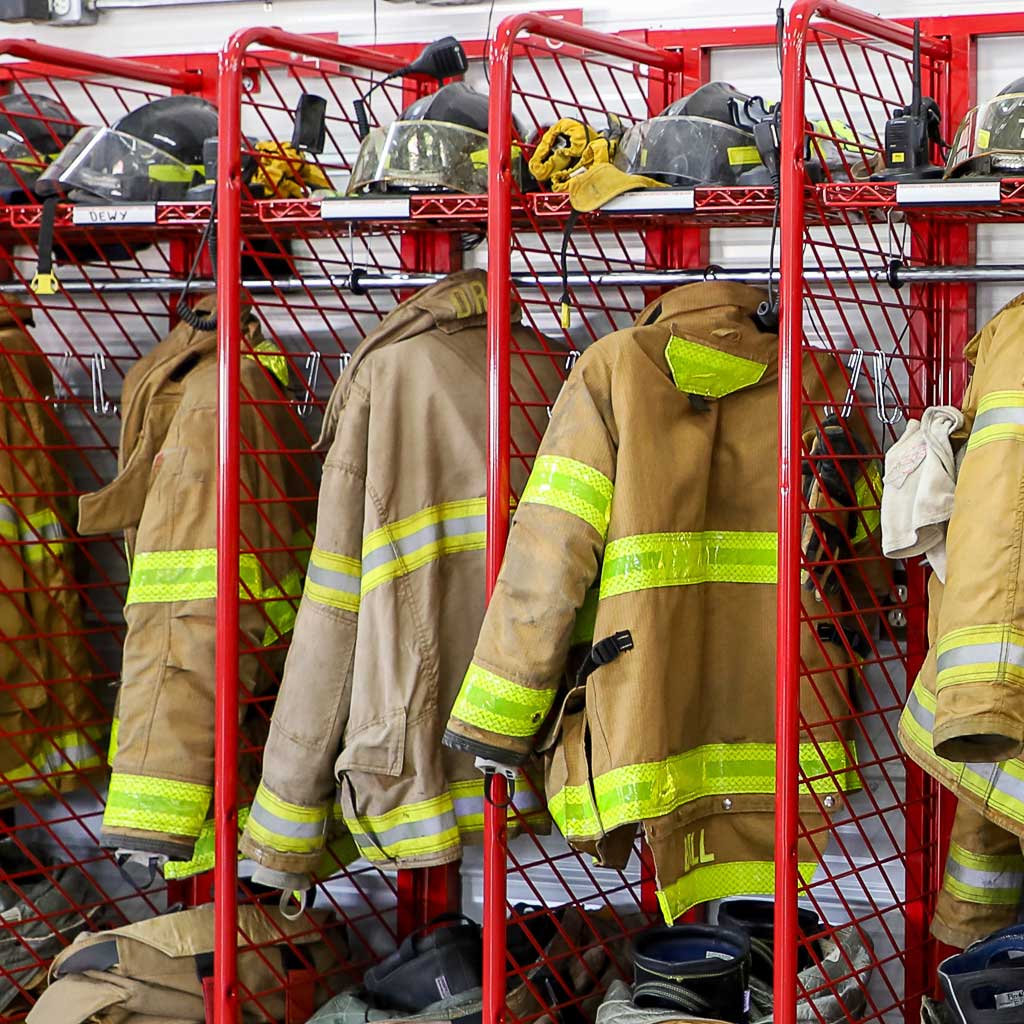
If your boots are wet every day, drying them properly isn’t a comfort question; it’s a foot-health, gear-cost, and (for some trades) safety question. Construction crews working in wet concrete and trench water, plumbers on slab repairs, linemen up poles in the rain, firefighters back at the station with bunker boots full of suppression water, EMS workers with bodily fluid contamination, oil-and-gas field workers in winter, dairy farmers in milking parlors these are people whose feet are wet 200+ days a year, often with boots that cost $200-$500 and need to last.
If your boots are wet every day, drying them properly isn’t a comfort question; it’s a foot-health, gear-cost, and (for some trades) safety question. Construction crews working in wet concrete and trench water, plumbers on slab repairs, linemen up poles in the rain, firefighters back at the station with bunker boots full of suppression water, EMS workers with bodily fluid contamination, oil-and-gas field workers in winter, dairy farmers in milking parlors these are people whose feet are wet 200+ days a year, often with boots that cost $200-$500 and need to last.
The math on a good dryer is unusually clear in this market. A pair of decent work boots costs $250 and should last 18-24 months under typical conditions. Boots that go back on damp every morning last 8-12 months. A $150 dryer pays for itself in extended boot life within a year, and that’s before counting the productivity gain of starting each shift in dry footwear.
This guide covers what actually matters for drying work boots — broken down by trade — without pushing any particular brand. The right dryer for an electrician working alone in a residential market is not the right dryer for a 12-firefighter station running 80-hour weeks.
Work boots dry differently than ski or hunting boots because most of the moisture is on the inside — sweat from a full shift in a closed-toe environment — not from external water. That changes which features matter most.
 Why Work Boots Need a Different Drying Strategy
A construction worker’s boots take in maybe 10-20% of their daily moisture from external sources (rain, puddles, wet concrete, snow). The other 80-90% comes from sweat from the feet inside the boot during 8-10 hours of physical work. That’s a fundamentally different drying problem than ski or hunting boots, where most moisture comes from outside.
The implications are practical: external moisture sits on the boot surface and dries relatively fast even with poor airflow. Internal moisture is locked into the insole, the foot-side of the liner, and the lower portion of the boot where the foot rests. Reaching that moisture requires air movement directly into the boot cavity — passive drying in a locker, a mudroom, or a garage simply doesn’t get there. The boot feels dry by morning but the interior is still wet, and within an hour of putting it back on, your foot is in a damp environment again.
This is why feet stay perpetually clammy at work even when boots seem to dry overnight, and it’s why work boot interiors break down faster than the external structure of the boot — the leather and rubber stay fine while the foam and fabric inside disintegrate.
What Actually Matters for Work Boot Dryers
1. Run Time and Reliability
Most consumer boot dryers are designed for 2-8 hours of daily use. Work boot dryers — especially in fire stations, contractor shops, and farm setups — need to handle 12-24 hours of continuous operation, sometimes seven days a week, for years. Cheap units with plastic ducting and consumer-grade fans burn out fast under this kind of duty cycle.
The features that matter for heavy use: metal construction (not plastic), brushless motors rated for continuous duty, replaceable parts, and either built-in timers or compatibility with outlet timers so the unit isn’t running unattended when it doesn’t need to be. For a single tradesperson, almost any well-built dryer handles the load. For multi-user installations, this is the biggest factor.
2. Multi-Pair Capacity for Stations and Shops
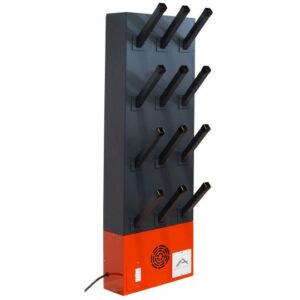
A four-firefighter rotation needs at minimum 12 ports (boots and gloves for each member). A construction company drying boots for a six-person crew needs six to 12 ports. A dairy operation with three farmhands needs six ports plus replacement insoles drying separately. Buying multiple two-port consumer units to hit these numbers is a false economy — it consumes outlet count, takes more floor space, and gives you multiple potential failure points instead of one robust unit.
Common matches: For 6-18 pair needs, Alpine Dryers PRO in the 6/12/18-pair configurations is widely deployed in fire stations and contractor shops. The DryGuy Dry Rack is a less expensive radiant-heat alternative for installations where silence matters and faster drying isn’t critical.
3. Material Compatibility with Work Boot Construction
Work boots vary significantly in construction. The dryer needs to handle whichever ones you actually wear:
- Leather work boots (Red Wing, Thorogood, Carolina, Danner) — heat-tolerant at low temperatures (95-105°F), vulnerable to high heat over time. Same rules as leather hunting boots.
- Steel-toe or composite-toe boots — the toe cap can act as a heat sink; air directed into the toe area dries the interior somewhat faster than non-safety boots. Heat sensitivity is otherwise the same as the base boot material.
- Rubber work boots (Tingley, Servus, Muck Chore) — broadly heat-tolerant. Forced air with heat works fine. These boots dry slowest because the rubber exterior is impermeable; air must enter through the cuff.
- Firefighter turnout/bunker boots — high-end leather or rubber with fire-resistant liners. Manufacturer guidance typically recommends low-heat or ambient air; high commercial heat can degrade the moisture barriers and shorten the certified service life of the boot.
- Hip waders and fishing-style waders — neoprene or PVC; ambient or low heat. High heat can damage seam tape over time.
The practical rule is the same as for any premium gear: 95-105°F (low heat) or ambient air is safe for everything. High-heat commercial blowers above 110°F save time but accelerate wear on premium boots used daily.
4. Sanitation Considerations (For Fire/EMS and Healthcare)
EMS providers and firefighters routinely encounter bodily fluids, contaminated water, and chemical exposure. Drying boots after a call isn’t just about moisture — it’s about reducing bacterial and viral load that can survive on damp surfaces. The same principles apply: complete moisture removal crashes bacterial populations and stops viral persistence, far more effectively than surface wipe-down alone.
Some departments use ozone-generating dryer attachments or UV-C sanitizing systems for additional pathogen control. These are supplements, not replacements — they work on dry surfaces, so the boot still needs to be genuinely dried first. Drying then sanitizing is the right sequence.
 How Different Trades Use Boot Dryers
Construction and General Trades
Boots come off dirty and damp at the end of each shift. Most users keep one or two pairs in rotation. Single-user setups work well with two- to four-port forced-air units; small crews with shared equipment do better with six- to 12-port multi-pair installations. Heat speeds drying significantly and is safe for the rugged leather and rubber construction typical of work boots, though leather boots benefit from ambient-air drying for longevity over the long term.
Firefighting Services
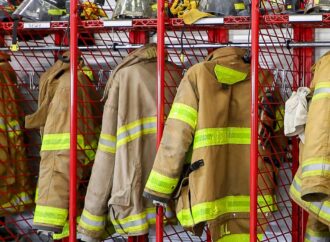
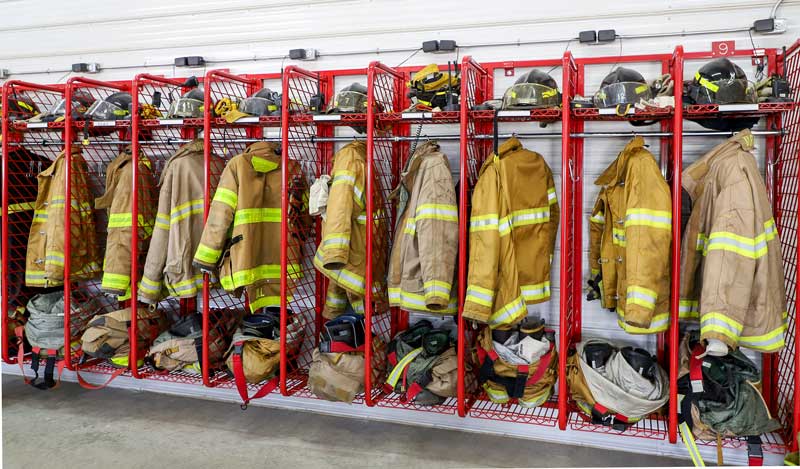
Bunker boots get saturated during suppression and decon. NFPA guidance emphasizes thorough drying before re-use to maintain liner integrity and reduce contamination risk. Stations typically need 6-18 port capacity depending on staffing and shift structure. Multi-pair forced-air units are the standard; some departments add ozone or UV-C sanitizing components.
A practical consideration: fire stations often have noise-sensitive sleeping quarters near the engine bay. Radiant-heat dryers (silent) are sometimes preferred over forced-air units for overnight drying when crews are sleeping. The trade-off is longer dry times — radiant units take 8-12 hours versus 1-4 hours for forced air.
EMS and Healthcare
Lower volume of soaking-wet conditions than firefighters but higher contamination concern. Many EMS providers benefit from a single multi-pair forced-air unit at the station, with provisions for boots that need decontamination before drying. Smaller departments often run two-port consumer units adequate for the duty cycle.
Agriculture and Dairy
Highest year-round wet exposure of any work category. Rubber boot use is dominant. Heat is helpful (rubber tolerates it well), and multi-pair units handle the boot count for typical farm crews. Outdoor or barn installation is common, so look for units rated for the temperature and humidity range of the install location.
Oil, Gas, and Field Services
Mixed conditions — winter freezing temperatures plus persistent moisture exposure. The frozen-boot challenge (where ambient air can’t dry ice-saturated boots effectively) makes heated forced air the standard. Mobile drying setups in trailers or camp facilities are common.
How Drying Methods Compare for Work Boots
| Setup | Typical Capacity Need | Best-Fit Style |
| Solo tradesperson, daily use | 2 pairs (rotation) | Two-port forced-air, selectable heat |
| Small crew (3-5 workers) | 6 pairs | Six-port forced-air unit or radiant rack |
| Mid-size company or department (6-12) | 12-18 pairs | Multi-pair forced-air with expansion ports |
| Fire station (single shift) | 8-16 pairs (boots + gloves) | Multi-pair forced-air; consider noise level |
| Large operation (15+ workers) | 18-24 pairs | Industrial multi-pair, often wall-mounted |
| Farm or ag operation | 4-8 pairs, year-round | Forced-air with heat; tolerant of barn humidity |
Buying Considerations Specific to Workplaces
Electrical capacity. Multi-pair units typically draw 4-8 amps; verify the install location has sufficient circuit capacity. Large 18+ pair units may need a dedicated 20-amp circuit.
Wall-mount vs. floor-mount. Wall-mount saves floor space in cramped station bays and contractor offices. Floor models offer easier loading and easier service access. Many manufacturers offer the same dryer in both configurations.
Warranty and serviceability. For high-duty installations, look for units with replaceable motors and field-serviceable components. A unit that can be repaired by replacing one part beats a unit that has to be replaced entirely when something fails.
Timer features. Built-in 2-12 hour timers prevent unattended overnight runs from extending into 24-hour cycles. For installations without built-in timers, $15 outlet timers do the job. Auto-shutoff is one of the cheapest ways to extend equipment life.
Tax treatment. For self-employed tradespeople, sole proprietors, and small businesses, work-related drying equipment is typically deductible as a business expense. Talk to a tax professional for specifics in your jurisdiction.
Common Mistakes Worth Avoiding
Buying for current capacity, not 2-year capacity. Crews grow, departments rotate, households add hunters. A six-port dryer at $300 is usually a better investment than two three-port dryers at $180 each — fewer outlets used, expandability for growth, and a single point of maintenance.
Skipping the insole removal. Same rule as hunting and ski boots. Pulling insoles cuts interior dry time meaningfully. For work boots used daily, this is a habit worth building.
Drying with safety toes against direct heat. Steel and composite toes conduct heat directly to the foot if the boot is hot when you put it on. Make sure cycle ends well before shift start, not just at shift start.
Ignoring smell. Persistent foot or boot odor at work usually indicates that the boots aren’t fully drying between uses. The problem is bacterial, not hygienic, and the fix is moisture removal.
The Bottom Line
For anyone whose boots get wet daily as part of their work, a properly sized boot dryer is one of the cheapest pieces of equipment in the entire setup — and one of the highest-ROI when measured against extended boot life, fewer foot health problems, and consistent dry footwear at the start of every shift.
The right dryer matches your boot count, your duty cycle, and your boot construction. For solo tradespeople, a quality two-port forced-air unit handles years of daily use. For crews and departments, multi-pair installations in the 6-18 port range are the standard. The wrong choice isn’t a particular brand — it’s an under-capacity, under-built unit that fails under daily commercial-grade use, or a passive setup that never actually gets boots dry through to the interior.
Where to Compare Your Options
The dryers mentioned in this article — along with units from PEET, Alpine Dryers, Zephyr, DryGuy, Cyclone, Williams, Chinook, GearDryer, and several other brands — are all available at CozyWinters, which carries over 60 dryer models across every price point and use case. It’s the most convenient place to compare side-by-side specs (airflow, heat output, port count, timer features) for work and duty boots since you can see every major brand in one catalog rather than checking each manufacturer’s site individually.
Models Commonly Referenced for This Use Case
- PEET Original — single pair, convection, silent. The entry point most buyers know.
- DryGuy Force Dry DX — forced-air with selectable ambient or 105°F heat. Compact two-pair design.
- Alpine Dryers PRO 6-Pair — multi-pair forced air for families, departments, or shared mudrooms.
- Zephyr 4-Pair — room-temperature air only, designed for heat-sensitive premium gear.
- DryGuy Dry Rack — silent radiant-heat rack, expandable, often used where noise matters.
Alpine Dryers is also available directly at alpinedryers.com, and most manufacturers sell through their own sites in addition to retail partners.