
Most gear dryers underperform because buyers focus on the wrong specs. Here is what airflow actually does, why heat is secondary, and how to ask the right questions before you buy.
Every gear dryer listing leads with the same things: wattage, drying time, number of pairs, temperature output. These specs look useful. Most of them are not.
Buyers who focus on wattage end up with a powerful heater that barely moves air. Buyers who focus on capacity end up with a 12-pair unit where only the two ports closest to the motor actually work. Buyers who focus on temperature end up damaging the liner materials they spent serious money on.
One spec drives actual drying performance: airflow. Specifically, whether the unit delivers consistent airflow to every port simultaneously, or whether it shares one motor’s output across everything and hopes for the best.
Why Moisture Leaves Gear in the First Place
Drying is an evaporation problem, not a heat problem. Moisture leaves a material when the air surrounding it can carry more water vapor than it currently holds. Moving dry air across a wet surface accelerates this exchange — the air picks up moisture and carries it away, replaced by more dry air, which picks up more moisture, until the material is dry.
Heat speeds up evaporation by raising the air’s capacity to hold water vapor. But heat without airflow is just a warm enclosed space — humidity builds, the air saturates, and evaporation slows or stops. Think of a sauna versus a clothes dryer. The sauna is hot. The clothes dryer moves air. One dries clothes; the other does not.
The Fan Problem in Budget Multi-Pair Dryers
Most multi-pair gear dryers use a single centrally located fan to push air through a manifold that splits into individual ports. On paper, this works. In practice, physics gets in the way.
Air follows the path of least resistance. The ports closest to the fan motor receive the highest pressure and volume. The ports farthest from the fan receive what is left after the air has traveled through the manifold and split multiple times. On a fully loaded 12-pair unit with a single fan, the difference in airflow between the closest and farthest ports can be significant.
The result: gear dries unevenly. The boots in port one are dry in three hours. The boots in port twelve are still damp at the liner in the morning. The unit technically worked. The gear did not technically dry.
Blowers vs. Fans: Why the Distinction Matters
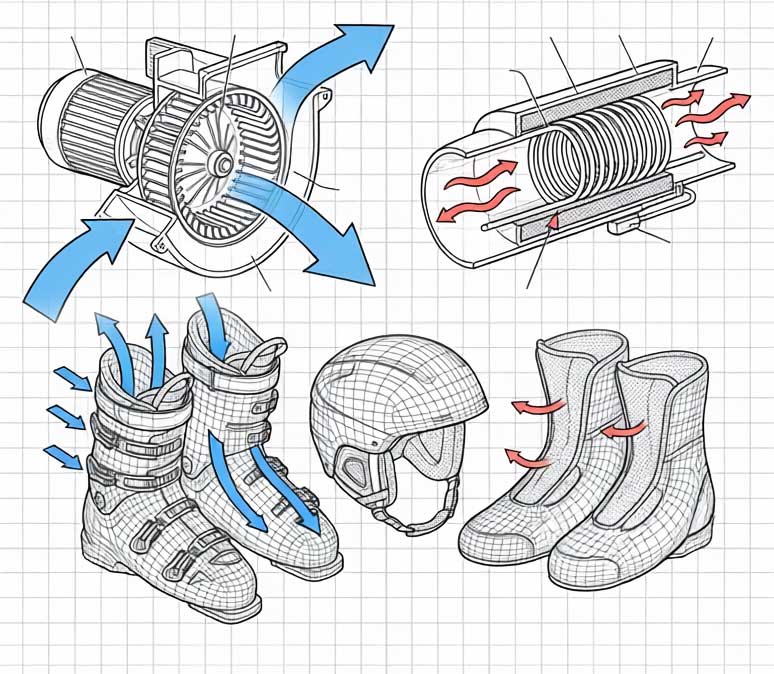
A blower is not a faster fan. It is a different type of motor that operates on a different principle.
Fans move air by spinning blades that push air forward. They produce high volume at low pressure, which means they lose performance quickly when resistance increases — like when you add boots, gloves, and a helmet to every port.
Blowers move air by spinning a wheel inside a housing that forces air out through a focused outlet at high pressure. They maintain output under load. Filling all the ports does not reduce their performance the way it reduces a fan’s.
This is why the Alpine Dryers PRO uses high-velocity blowers rather than fans. Blowers cost roughly six times more to manufacture. The tradeoff is consistent airflow at every port regardless of how loaded the unit is.
The Zephyr line from Alpine Dryers uses an industrial-grade fan specifically selected and tested to maintain full airflow across all ports when loaded — a different approach that solves the shared-fan problem for daily users who want room-temperature drying.
What Heat Actually Does — and When It Becomes a Problem
Heat is useful in two situations: when gear is very wet and needs to dry fast, and when ambient conditions are cold and evaporation would otherwise be slow.
It becomes a liability when applied too aggressively or too frequently. Boot liners are layered foam and fabric with heat-sensitive adhesives. Repeated high-heat exposure can:
- Degrade adhesives that bond liner layers, leading to delamination
- Compress and flatten foam liners designed to retain their shape for fit and warmth
- Alter the flex profile of plastic boot shells over many cycles
- Damage Gore-Tex membranes in waterproof boot liners
This is the design logic behind the Zephyr. Room-temperature air only. For daily users who run the same boots through the dryer five or six days per week, this preserves liner integrity and boot fit over the life of the gear.
What to Actually Ask Before Buying Any Gear Dryer
- Does each port have its own dedicated airflow source, or does a single motor share output across all ports?
- What happens to airflow at the farthest ports when every port is fully occupied?
- What is the maximum air temperature, and does the unit have a lower heat setting or ambient-only mode?
- Does the unit have an auto-shutoff timer, or does it run until unplugged?
- Are replacement parts available off-the-shelf, or are they proprietary components that may stop being manufactured?
The Setup That Gets Airflow Right
The Alpine Dryers PRO starts with the airflow question and builds from there. High-velocity blowers, one per expansion unit, maintain full output at every port regardless of load. The PRO expands from 6 pairs to 12 to 18 — and because each module has its own blower, drying performance stays consistent as capacity grows.
The Zephyr solves the same problem for daily users: an industrial-grade fan tested specifically for full-load performance, available in 2-pair and 4-pair configurations with wall-mount options.
Both lines are available at CozyWinters, which carries the full Alpine Dryers catalog including boot hose extensions for tall ski boots and helmet holders.