
Search this question and you’ll get answers ranging from “a few hours” to “overnight” to “three days.” Most of those answers are wrong, because they’re measuring the wrong thing.
How Long Does It Take to Dry Ski Boots? (And Why Most People Get It Wrong)
Search this question and you’ll get answers ranging from “a few hours” to “overnight” to “three days.” Most of those answers are wrong, because they’re measuring the wrong thing.
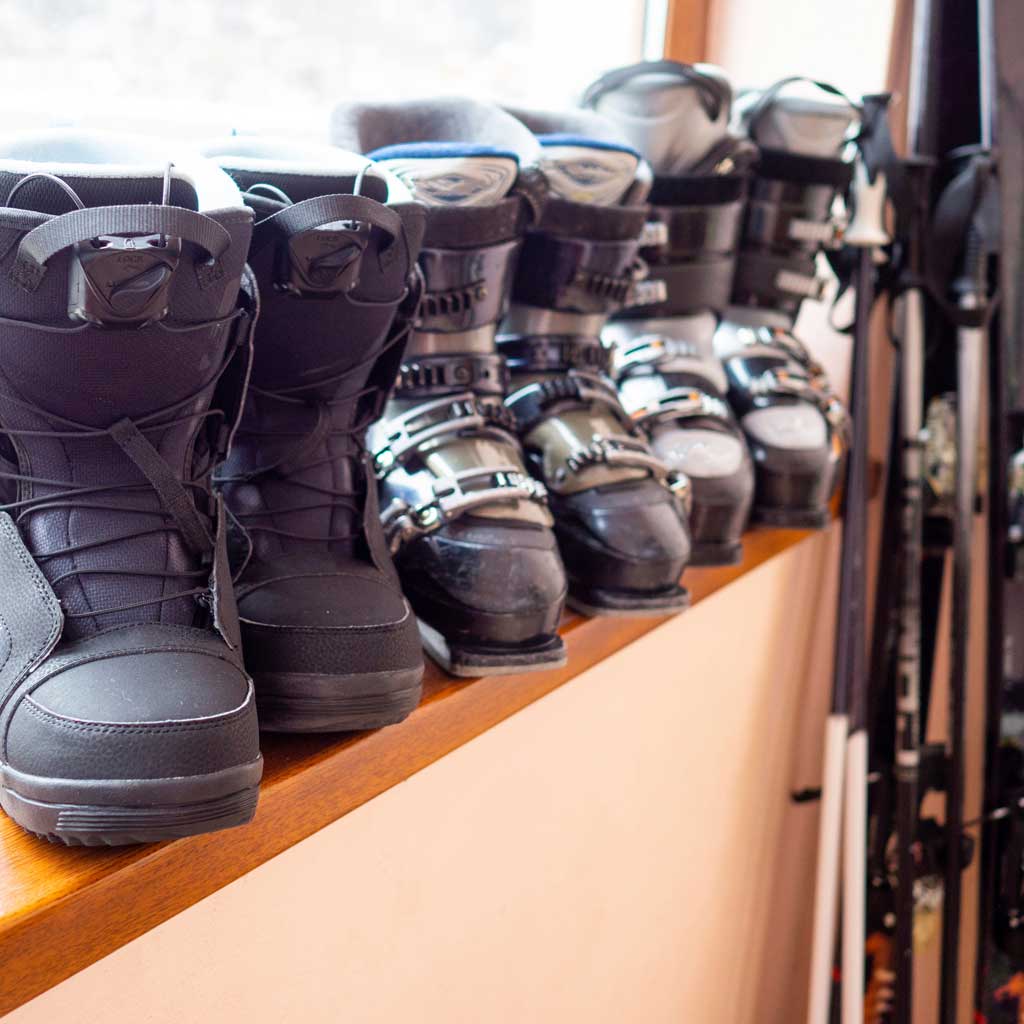
A ski boot can feel dry on the outside while the liner is still saturated. The shell rigidifies before the foam, the foam dries before the seams, and the seams dry before the inner layer that sits against your skin. Pull the boot on the next morning, body heat hits trapped moisture, and the bacteria that survived overnight start producing odor again — usually within 90 minutes.
So the real question isn’t “how long until my boots feel dry.” It’s “how long until they’re actually dry, all the way through.” Here’s what that looks like by method.
If a drying method only addresses the surface, you’ll spend the season fighting odor, cold feet, and prematurely worn liners — without ever realizing the gear was never fully dry.
The Moisture Science in 60 Seconds
Ski boots are closed-end garments. They have one opening, an interior cavity, and dense liner foam designed to insulate. That construction is great for keeping your foot warm — and terrible for letting moisture out.
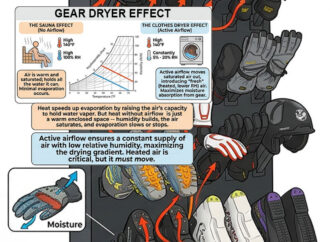
Sweat plus melted snow saturates the liner foam and inner sock layer during a ski day. That moisture has two ways out: evaporate into the air around the boot, or wick outward through the shell. Both paths are slow, and both depend on three things:
- Air movement — moving air carries moisture away from the surface so more moisture can evaporate from below it. Still air saturates quickly and stops drying.
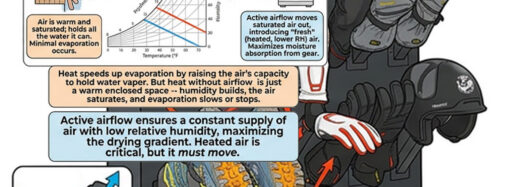
- Air temperature — warmer air holds more moisture, so it can absorb more before it’s saturated. But heat alone, without airflow, just bakes moisture deeper into the liner.
- Surface area exposed to that air — a boot sitting on the floor exposes maybe 20% of its interior to ambient air. The rest stays sealed.
This is why airflow is the dominant variable. Without forced air pushing into and out of the boot’s interior cavity, you’re relying on slow diffusion — and slow diffusion takes days, not hours. (We dig into this further in Airflow vs. Heat: The Only Spec That Actually Matters in a Gear Dryer.)
Dry Times by Method (Honest Numbers)
These ranges assume a moderately wet boot after a full ski day — soaked liner, damp shell, no standing water. Times will be longer for boots used in spring slush or rain, shorter for boots used on a cold, dry day.
| Method | Time to Dry | What Actually Happens |
| Boot left on the floor | 48-72 hours | Slow diffusion. Liner often still damp on day three, especially in humid basements or mudrooms. |
| Newspaper stuffed inside | 24-48 hours | Newsprint absorbs surface moisture but saturates within a few hours; deeper liner stays wet without replacement every 4-6 hours. |
| Boot bag near a heater | 12-24 hours | Heat without airflow. Outer shell dries fast, interior bakes moisture into liner. Common cause of premature foam breakdown. |
| Box fan blowing into boot | 8-16 hours | Real airflow, no targeted delivery. Air enters the cuff but doesn’t reach the toe box. Toe stays damp. |
| Convection gear dryer (e.g., PEET Original) | 8-12 hours overnight | Warmed air rises gently through the boot. Silent, safe, slow. Best when you have all night. |
| Forced-air gear dryer, ambient | 4-8 hours | Industrial fan pushes room-temp air directly into the boot interior. Safe for any material, no heat damage risk. |
| Forced-air gear dryer, low heat (95-105°F) | 1-3 hours | Warm forced air. Fastest reasonable option for repeated daily use. Heat is gentle enough to spare adhesives. |
| Commercial high-heat blower | 20-60 minutes | Used in ski resorts. Fast, but cumulative heat exposure shortens liner life on home gear used daily. |
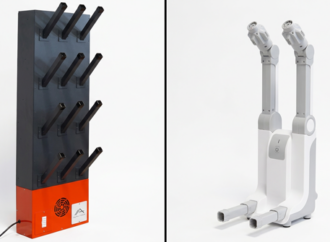
The methods at the top of this table are essentially passive. The methods at the bottom — the Alpine Dryers PRO 6-Pair with its self-regulating heater, or the Zephyr 4-Pair for ambient room-temperature drying — are designed specifically to push air into the closed cavity of the boot, which is the entire reason they work in hours instead of days.
Why “Overnight” Is the Wrong Goal
Most people aim for “dry by morning” because that’s when they need the boots again. Fair enough. But aiming for “dry by morning” with a method that takes 12+ hours means the gear is barely dry when you put it back on — and the next ski day starts with a liner that already has trapped moisture from the day before.
Over a full season, that residual moisture compounds. Liners stay slightly damp 100% of the time. Bacteria establish a permanent population. Foam loses its rebound 30-40% faster than it should. The boots that should last six seasons last three.
The fix isn’t more aggressive drying — it’s drying that finishes well before you need the gear again, so the liner has time to fully equilibrate with room air.
How to Cut Dry Time in Half (Without Buying Anything)
If you’re not ready to invest in a gear dryer, three changes will dramatically improve whatever method you’re using now:
- Pull the liners. Most modern ski boots have removable liners. Take them out. The shell dries on its own; the liner dries 3-4x faster when separated. This single step cuts most overnight drying jobs by half.
- Open the boot fully. Loosen every buckle, pull the tongue forward, fold back the cuff. The more interior surface area exposed to air, the faster moisture leaves.
- Move air across, not just near. A small fan blowing across an open boot at floor level works dramatically better than a fan blowing into the room generally. Targeted airflow is the entire point.
These three changes turn a 48-hour passive dry into a 12-16 hour reasonable dry. They don’t solve the deeper problem — closed-end garments need forced air directed inside the cavity to dry fully — but they’re a meaningful improvement at zero cost.
When a Gear Dryer Becomes Worth It
The math gets clear once you ski more than a handful of days a year. A pair of mid-range ski boots runs $400-$700. Liners can be replaced separately for $150-$300, but most people don’t — they buy new boots when the originals break down. Drying gear properly extends boot life by 30-50%, which on the average ski household pays for a quality dryer within two seasons.
More importantly: dry boots are warmer boots. Moist garments are roughly 23 times colder than dry ones. A dryer that gets your liners genuinely dry every night isn’t a luxury — it’s the difference between a comfortable ski day and the kind of cold that makes people quit halfway through.
If you’re evaluating dryers, the spec that matters most isn’t heat — it’s airflow per port. Cheap multi-pair units share a single fan across all ports, so airflow drops sharply once the unit is loaded. Quality dryers like the Alpine Dryers PRO line use blowers (or one fan per port) to maintain consistent airflow at every position regardless of capacity. For a deeper comparison across brands, see our independent buyer’s guide.
The Bottom Line on Dry Time
There’s no single right answer to “how long does it take to dry ski boots.” The honest answer is: it depends entirely on how much air is moving through the interior of the boot.
Sitting on the floor, plan on two to three days. With a forced-air dryer using ambient air, plan on four to eight hours. With heat added, plan on one to three hours. The drying method changes the answer by a factor of 30 or more.
If your gear is wet by the time you’re reading this article, your method isn’t working. The good news: the fix is straightforward, and most of the gain comes from getting airflow into the boot — not from spending the most money.
Where to Buy
Both Alpine Dryers and Zephyr — along with PEET, DryGuy, Cyclone, and the rest of the major brands — are available at CozyWinters, which carries over 60 dryer models so you can compare every option in one place. Alpine Dryers is also available directly through Alpine Dryers.
Most Popular Models
- Alpine Dryers PRO 6-Pair — the standard for families and serious skiers, expandable to 24 pairs.
- Alpine Dryers PRO 12-Pair — for larger households, ski homes, or shared mudrooms.
- Zephyr 4-Pair — room-temperature air, designed for daily use on premium gear.
- Zephyr 4-Pair Wall-Mount — same dryer, wall-mounted configuration.
- PEET Original — silent, low-wattage, single pair, 25-year warranty.